Insight
October 2, 2026
Rethinking Casualty Evacuation for a Contested Indo-Pacific
.avif)





In a contested fight, getting casualties out — and getting critical medical supplies in — becomes a fundamentally different problem.
In this podcast conversation, Lyntris’ Ben Pinx - a former U.S. Army Chief of Experimentation - joins Maj. Sarah Blackthorne of the National Guard to discuss how distance, contested airspace and limited resources could challenge traditional approaches to casualty evacuation in the Indo-Pacific.
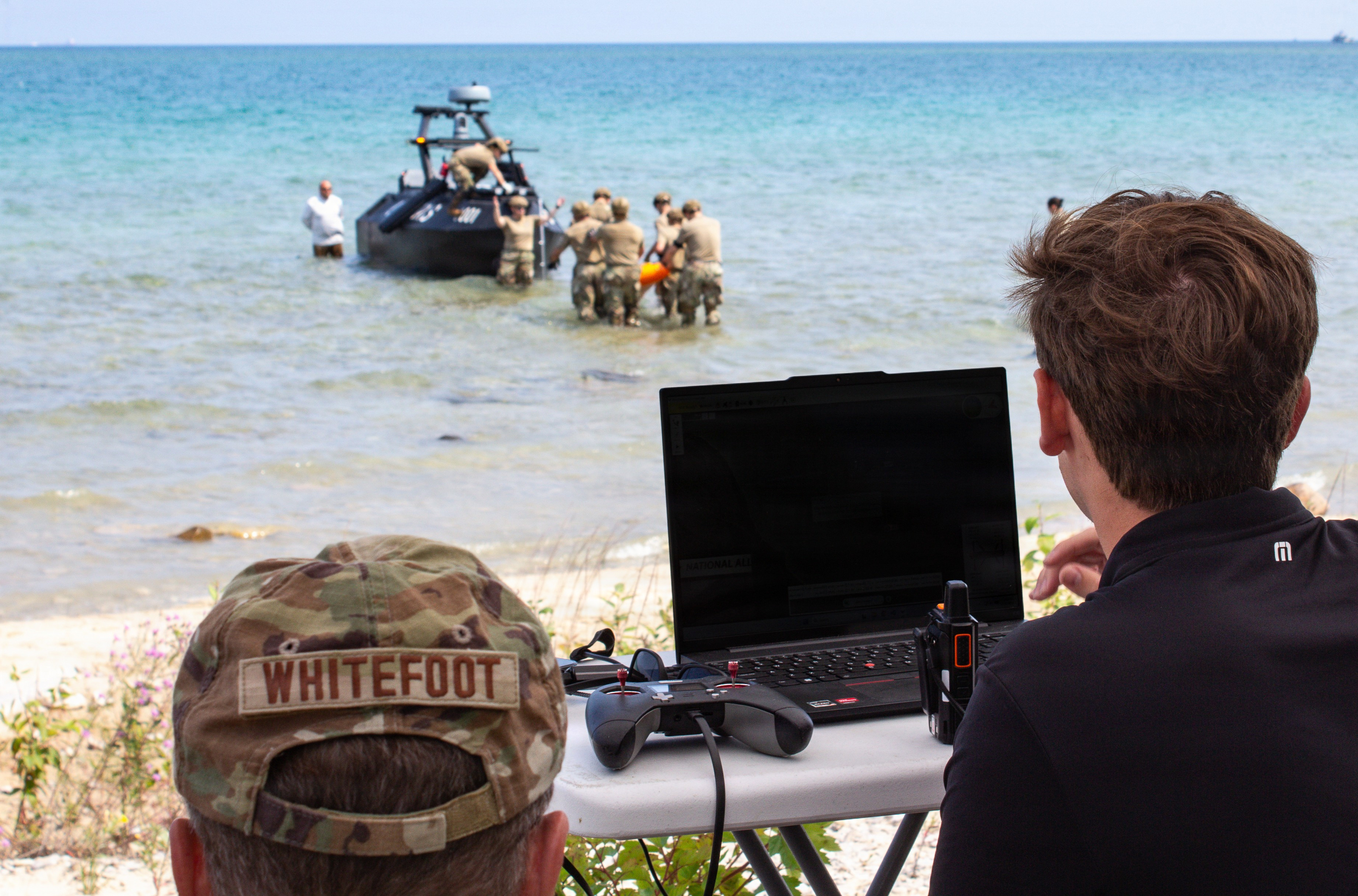
The conversation explores the distinction between CASEVAC and MEDEVAC, the need for interoperable and multi-mission platforms, and lessons from Northern Strike, where the Lyntris MV-20 unmanned surface vessel was used to demonstrate medical resupply and casualty evacuation concepts.
They also discuss what comes next: integrating autonomous platforms into joint operations, designing technology around evolving mission needs and closing the gap between experimentation and operational use.
Highlights from the Conversation
The conversation below has been edited and condensed for length and clarity.
Why casualty evacuation gets harder in a contested fight
Sarah Blackthorne: First, I want to define two terms: CASEVAC and MEDEVAC. MEDEVAC is a dedicated platform for medical evacuation. It typically comes with flight medics or personnel who are medically trained, and it is better equipped to sustain transport of that patient.
CASEVAC is putting a casualty on any platform that’s available to get them out and move them to the next level of care. We’re making the assumption that CASEVAC is going to make up for a lot of the ways we’ll try to move patients when we have contested airspace or we’re in some other form of non-permissive environment.
“The tyranny of distance” is a phrase you’ll hear. The Indo-Pacific is so spread out. It’s lots of island chains, but there’s more water than there is anything else. Coming from an Air Force perspective, our entire branch operates around airplanes. What happens when you can’t fly because your adversary has just as good, if not better, capabilities? Or your capabilities are degraded because your adversary is able to suppress your ability to use them?
That’s where we started thinking: What are some other ways we could move patients? We looked at how we would get supplies to medics or a unit on the ground that has a lot of casualties. And then: If a platform is bringing in supplies, could we also send a patient back with it under certain conditions?
Building one platform for multiple missions
Ben Pinx: The Army has the same problem the Air Force has. The Marine Corps has the same problem the Army and Air Force have because these are island-based problems: How are we moving things?
Look at this through the lens of running munitions between islands. I have to resupply before firing batteries go Winchester. Or maybe I’m running pure logistics. Why am I not also using this to do other things? Casualty evacuation. ISR.
If I’m moving between the island chains, I can have persistent ISR. I’ve got a web of these boats that are retaskable on demand.
There are a lot of USVs out there doing some very exquisite things. What they can’t do is change on a dime. What you have to find are platforms that are multi-variant.
In this instance, we looked at it through: How do we service the joint force, not just a service?
Making people and platforms more adaptable
Sarah Blackthorne: Ben mentioned CCATT, a Critical Care Air Transport Team. These are teams of three personnel who are incredibly expensive to recruit, train and retain: a critical care doctor, an ER or critical care nurse, and a respiratory therapist.
But when we can’t fly, do we take this incredibly expensive asset that is specifically a Critical Care Air Transport Team and just ground them? Or do we try to take these highly specialized teams and make them a little more platform agnostic? Maybe CCATTs can operate on boats, on the ground or somewhere else. And then, could we look at platforms that are capability agnostic?
If I see something bringing supplies in that could carry a patient back, or that could also provide ISR capabilities, what we want to look for are things in our inventory that are multipurpose — that are not so niche that they can only perform one function.
That’s where CASEVAC opens the aperture for us versus MEDEVAC. MEDEVAC is going to be very busy, and we can’t guarantee it’s going to be there. But anything could theoretically be CASEVAC.
What that could look like with the MV-20
Ben Pinx: Think of a fleet of these moving in and around the first and second island chains, doing multiple missions and being retasked. If you’ve got all these boats out there, how do we “Uber-ize” this at the orchestration layer? Maybe one is headed to pick something up, but picking up a CASEVAC is more critical. It gets rerouted.
That’s where the technology is right now. When the Army buys something, we buy it for 30 or 40 years. We’re not getting rid of it in two, three or five years. Whatever you’re building has to be multipurpose.
If I can solve for a number of problems with a single platform, why not do that?
Interoperability across the joint force
Sarah Blackthorne: One of the biggest conversations when it comes to any new technology is interoperability. I need it to be able to function whether I have an Army patient, an Air Force patient, a Marine patient and so on. I need that patient to be able to go on this platform regardless of the team that touched them or what type of equipment they use. Can I plug it into this platform? Is it going to get where it needs to go? Is that patient’s life going to remain stable throughout the course of that? If only one branch can use this, what value does it bring to the overall joint force?
We’re buying things that we assume we’re going to use for the next 20 to 30, maybe even 40 years. We think we know what war is going to look like in the next two to five years. But in 30 years, we really don’t know.
We can make assumptions about what we think we will need, but world powers shift and change, and geopolitics are unpredictable.
Putting the MV-20 to the test at Northern Strike
Sarah Blackthorne: The demonstration we were targeting was the ability to move, first of all, medical resupply — Class VIII material. Class VIII A is our medical supplies and B is blood.
During contested logistics, distance compounds the problem even more. How do we get resources to teams on the ground?
Then, “Can we move patients?” was our secondary question. That was how we originally approached Ben and the team from Lyntris: Could we put blood and some medical supplies on your platform and have it come in? Then that conversation rolled into: How big is the inside of that? Can we fit a patient in there? We know getting resources somewhere is probably the near-term solution we’re trying to solve for. There are lots of red tape and ethical questions that need to be cleared before we can put actual people into these platforms.
During Northern Strike, we wanted to see what we were capable of doing. It doesn’t necessarily prove we can do this at scale. We know there’s a capability, and then it exposes some seams for us. Could we put this into a battle management system where it integrates with our technology and we’re able to see where these platforms are and request them — just like the idea of a CASEVAC Uber? We initially approached this from contested logistics because we know that is a big gap for us: How do we move things when we can’t fly planes?
The MV-20 was one of the platforms we chose because of its unique capabilities.
What the experiment taught the Lyntris team
Ben Pinx: The original ask was just blood resupply. We said, “We can put four JAGMs in there. Why can’t we put a giant refrigerator?” We’ve got the power. We can handle the weight. We can get it there. But there were questions. How does blood sustain over long periods in a Sea State 3-plus environment? Then we bridged the conversation to: What if we put a person in it?
We realized that the space was very constrained because we had designed it for specific payloads. That got us thinking through how the design could change.
We’ve also had conversations around telemedicine capability and what would be required to sustain some of those medical requirements. A lot of that came out of Northern Strike.
Why operator feedback matters
Sarah Blackthorne: We actually had our ground surgical team participating in the exercise overall. We pulled them into this smaller scenario because they are the SMEs. They are the ground surgical team that might have to load this patient onto this capability during combat, so we wanted to get their feedback.
During the initial practice, one of their first points of feedback was that the existing litter cage just didn’t work. It actually made it a little harder to get a patient in there. They went with the SKED, the flexible one that you saw with the mannequin inside of it, and that worked great. It was easy for them to carry and easier for them to load.
It’s really great for our teams to be able to give that in-the-moment feedback to companies that are bringing their tech, because these companies get the ability to go, “Oh, hey, you know what? We thought of this, but we didn’t think of that.” That’s part of the value in exercises, especially like Northern Strike.
The Lyntris team on the ground was so excellent to work with. They were so helpful, so responsive. They were hungry for the information and for the experience because they had people who would really use this technology in combat giving them feedback on how the technology was working for them.
That’s the value to me: not only saying, “Okay, we tested this capability,” but now thinking about the ways we need to test it more to see what our true left and right boundaries are — and also providing that feedback to the company.
From successful experiment to operational capability
Sarah Blackthorne: From my perspective, it is 100% the bureaucracy. I’m part of that bureaucracy. Working governance and policy, I sit in a lot of those meetings. I see how long it takes for decisions to get made.
This is no shade to the government, but when we’re using taxpayer dollars, there are rules and regulations around how you use them. Even if we knew we had amazing technology — which we saw at the exercise — it could be years before, if I were the end user, I would actually put my hands on it operationally because it takes so long to get it through that federal process.
Ben Pinx: I would say there’s no lack of CONOP, concept of employment. I think if you go down and work with the actual units in any of the services and give them access to the capability, they’re going to employ it and they’re going to get after it today.
The long pole for me is twofold: the requirement refinement that gets you to an acquisition cycle, and then the fiscal constraints put on you by the bureaucracy above the services. If the Air Force came to me tomorrow and said, “Ben, we need 100 of these. Here’s where we’re going to employ them in the CONOP. Here’s how we’re going to employ them in the concept of employment,” we’d get after it. Because we don’t have five years to wait.
Understanding the real problem
Ben Pinx: One of the most beneficial things I brought from more than two decades in the Army into industry is understanding what the real problem is. There are a lot of great people who come in and say, “Hey, I’ve got a thing.” But sometimes you have to explain, “That’s a phenomenal capability. I can’t use it.”
You have to sit and listen to what the soldiers, airmen, Marines or whoever you’re talking to are saying, because that’s who has to use your stuff. I can tell you, too often I left things in the CONEX box back in the rear because they were just taking up space.