Insight
August 27, 2026
When the Golden Hour Ends: Why Casualty Care Is Becoming a Logistics Problem
.avif)





For years, American battlefield medicine ran on a single promise. Get a wounded soldier to surgical care inside an hour (the “golden hour”) and they will most likely live. The promise held because we owned the sky and the distances were short, and it produced the highest casualty survival rate in the history of war, around ninety-two percent by the Army's own count.
The Military Health Systems is already moving
In Military Review last summer, senior trauma leaders wrote that evacuating casualties to an operating room inside the golden hour will be a luxury in large-scale combat, because the environment will be too contested and too congested to count on it. The speed at which a wounded body bleeds out has not moved, and no amount of doctrine will move it. For twenty years a fast helicopter made up the difference, but in the Pacific it often won't be there.
The Army Medical Department is reorganizing around that reality for a Pacific fight. Its own writing on sustainment in large-scale combat is blunt about the tyranny of distance, about casualties who could end up isolated on an island with a long, contested trip across open water between them and definitive care, and about drones making air medevac more dangerous than it has been in a generation. The medical planners preparing for the Indo-Pacific describe the same wall: no assured air superiority, enormous distances, limited platforms, and the strong likelihood that moving a patient means exposing a medevac crew to fire. Analysts writing on the future of CASEVAC go further, arguing that evacuation doctrine inherited from the Global War on Terror is built for a war that no longer exists. The answer they keep landing on is prolonged casualty care, holding and treating the wounded far forward for hours or days because the ride out is not coming the way it used to.
Blood is the reason, and blood is logistics
Strip the problem down and it comes back to one commodity. Hemorrhage is the leading cause of preventable death on the battlefield, and most troops who die from otherwise survivable wounds bleed to death before they reach a surgeon. The intervention that changes the outcome is whole blood, given early, as far forward as you can get it.
Getting it there is where medicine turns into logistics. Military planning factors hold that around a fifth of casualties will need transfusion, averaging roughly eight units of whole blood each. Hundreds of units move around the globe every week under an unbroken cold chain, and a Ukraine-scale fight could generate an average of several thousand casualties a month in the first year alone. Forward units are now required to keep walking-blood-bank plans just to cover the gaps. Then there's what happens under real strain. A recent simulation of a forward surgical detachment's blood supply found the chain can collapse in about two days once daily casualties climb past thirty, and that even a hundred-donor walking blood bank buys little margin once the rate reaches fifty a day. A single badly wounded casualty can drain every unit a small facility has on hand. And the cold chain that keeps all of it viable still leans on iced containers that have to be re-iced every couple of days.
A movement toward trusted autonomy
Across the services and defense research community, the conclusion is increasingly the same: shift transport missions to autonomous systems so medical personnel can stay focused on patient care.
DARPA's ANCILLARY effort, accelerated this year under a demonstration called EVADE, is building uncrewed VTOL aircraft that launch from ship decks and rough terrain with no fixed infrastructure, carrying useful payloads over long distances for logistics, ISR, and resupply. DARPA has also gone looking for robotic medics that could reach and stabilize casualties when human care is overwhelmed. On the ground, the 173rd Airborne Brigade ran drone-based blood resupplyduring a full hospital exercise in Lithuania last year, with the stated goal of pushing whole blood as far forward as possible without sending soldiers driving it into hostile areas. Behind all of it, the Defense Health Agency's Armed Services Blood Program is building out its Pacific capacity and partnerships to feed the theater in the first place.
Most of that work is airborne or on land, but the Pacific problem is also a water problem. The distance between a casualty on a distributed island position and the nearest surgical team is measured in open ocean, and there's no road to drive blood down. That's the problem our team has been working: moving blood and casualties over water.
Where the MV-20 fits
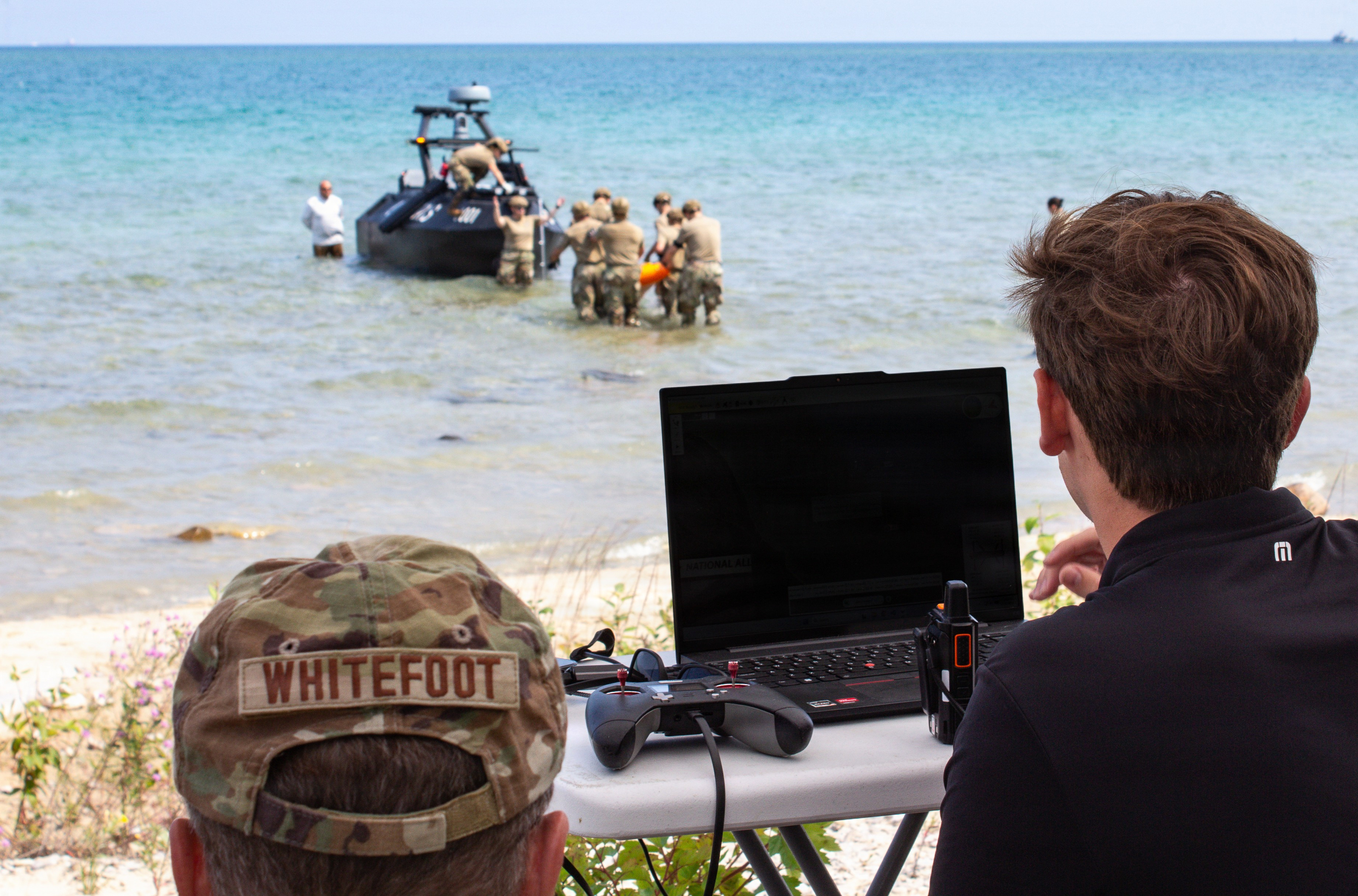
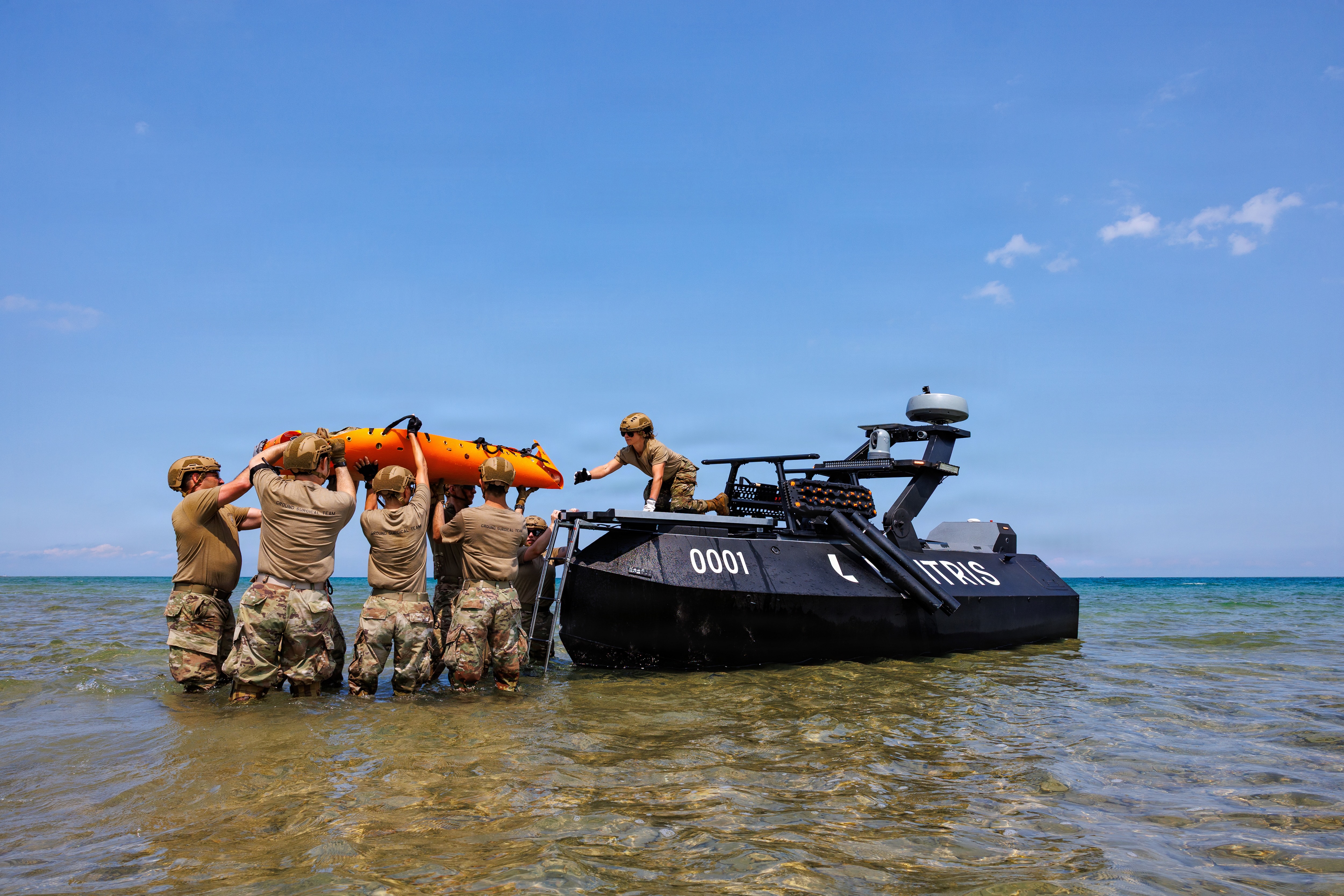
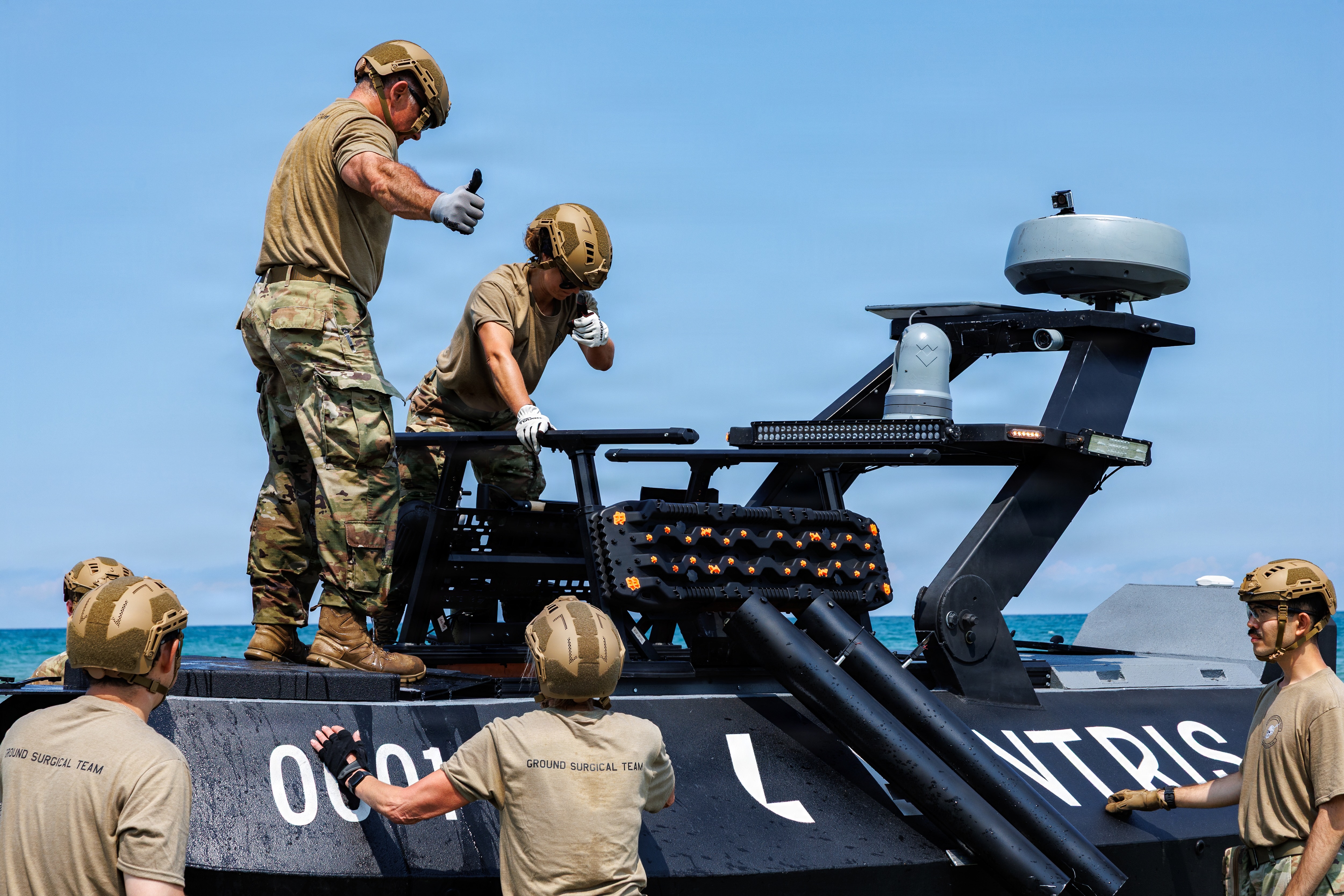
At Northern Strike this year, with the Michigan National Guard, we put an uncrewed MV-20 to work on exactly this mission. The boat launched offshore and transited on its own autonomy toward the landing point, carrying refrigerated blood so the cold chain held the whole way in. The combat casualty care teams met it at the waterline, took the blood, and loaded a patient litter. The MV-20 backed off and carried the casualty out over open water.
The Critical Care Air Transport (CCAT) Teams worked the shoreline the way they always do. What changed was the leg over the water, the stretch you would normally put a helicopter and an aircrew on. This time the boat handled that on its own, and nobody had to be out there with it. Northern Strike runs a simulated Indo-Pacific scenario now, using the Great Lakes as a stand-in for an island fight, which is the right place to test it.
The challenge: sustaining medical readiness under contested logistics
Blood is only one of the critical resources that must move through a contested battlespace, alongside fuel, ammunition, batteries, water, and repair parts. Together, they define the readiness challenge the Joint Force is organizing itself around. Casualty care is among the most unforgiving parts of that problem, because when the supply chain fails there, the consequences are measured in lives.
The MHS strategy names three pillars — a medically ready force, a ready medical force, and health care delivery. In the Pacific they meet at a single point: something has to physically arrive somewhere, on time, over water.
The MV-20 carries a ton, fits in a standard container, and changes jobs depending on how you kit it. Mostly it's a way to keep a force supplied when supplying it is hard. It moved blood and a casualty last month. It moves whatever the fight is short of next time, and it runs the routes that get crews killed with no one aboard. When CASEVAC gets this hard, everyone lands in the same place: move the sustainment load onto autonomous systems and keep people off the runs nobody should have to make.
The appearance of U.S. Department of War (DoW) visual information does not imply or constitute DoW endorsement.