Insight
August 6, 2026
From Awareness to Action in Contested Maritime Environments
.avif)





For many coastal nations, the first generation of maritime domain awareness (MDA) investments was designed to answer a relatively straightforward question: What legitimate commercial traffic is operating within or approaching our waters? Systems built around AIS, networked coastal radar, electro-optical (EO) sensors, and commercial tracking data dramatically improved visibility into maritime traffic and provided a meaningful step forward for fisheries management, border security, and maritime safety.
While that was a genuine step forward, those systems were built around cooperative behavior — they assume vessels report who they are and where they are going. That assumption still holds for legitimate traffic, and those capabilities remain valuable. But a growing share of activity is intentionally deceptive, unreported, or designed to exploit exactly those assumptions.
Why Maritime Domain Awareness alone isn't enough
The same systems that provide excellent awareness of legitimate maritime traffic become far less reliable once vessels deliberately manipulate—or abandon—them. Lloyd’s List Intelligence documented a pronounced rise in AIS spoofing through 2025 as an expanding shadow fleet used the tactic to disguise sanctioned cargo, and analysts recorded more than two hundred spoofing events in a single month last year, well above the preceding average. Behind that activity operates a shadow economy of roughly six hundred tankers carrying close to a tenth of the world’s seaborne oil, moving between identities, transmitting false positions, and going dark for extended stretches.
The manipulation extends well beyond sanctions evasion into deliberate coercion. Analysts have tied dozens of undersea-cable damage incidents across 2024 and 2025 to state-aligned vessels operating near critical infrastructure, and in one closely watched case Taiwan’s coast guard detained a Togo-flagged, Chinese-crewed vessel that had lingered near a submarine cable connecting Taiwan to its Penghu Islands around the time the cable was severed. Fishing fleets that maneuver like patrol formations, and the 2025 confrontation near Second Thomas Shoal, follow a common logic: applying pressure beneath the threshold that would justify a military response, and leaving the coastal state to absorb a run of ambiguous incidents that gradually shift the balance of control.
Investment is following the threat, and much of it stops short
The money follows the threat, and the clearest signal is what governments are actually buying. In April 2025 the United States approved a $131 million foreign military sale of Indo-Pacific Maritime Domain Awareness capability to India, built around the SeaVision maritime picture and aligned with the Quad’s IPMDA initiative. Egypt has been standing up its own maritime domain awareness program, notified in 2020 as a $417 million foreign military sale, to strengthen surveillance across the Mediterranean and the approaches to the Suez Canal. These are two recent points on a much longer line of MDA and coastal-surveillance procurement across the Indo-Pacific, the Middle East, and Africa, where territorial disputes, chokepoint traffic, and competition over resources overlap. The shared aim is to see more of the maritime domain, more clearly, more of the time.
That investment is necessary, and better sensing always helps, yet it carries a ceiling that is easy to overlook when most of the spending flows into collection alone. The gap opens after the picture forms. At the tactical edge an operator still fuses feeds by hand under pressure, and as information moves up the chain it thins and lags, so decisions are made against a view that has already aged. A coastal state can invest heavily in awareness and still find itself watching a problem it cannot act on in time, at which point sensing on its own reaches its limit unless something carries the picture forward into action.
Emerging technologies are beginning to change the economics of maritime awareness. Persistent unmanned vessels, lower-cost space capabilities, and distributed sensing can extend maritime presence well beyond what many coastal nations could traditionally afford. They increase the probability of detecting suspicious activity—but they do not eliminate the operational challenge of responding. Detecting an illegal fishing vessel 150 nautical miles offshore remains only the beginning of the mission; maritime security still depends on coordinating people, assets, and partners capable of intercepting, boarding, and enforcing the law. In other words, better sensing expands what is possible; command and control determines whether it changes the outcome.
From awareness to coordinated action
Operational advantage lives in the layer that sensing never reaches: turning the picture into planned, coordinated, and continuously deconflicted action faster than an adversary can react. That layer resists the off-the-shelf model, because a command-and-control system has to fit a particular navy’s sensors, command structure, and coalition partners rather than a generic template. Yet few nations can afford the opposite extreme, commissioning and sustaining a fully bespoke system built from scratch. The approach that fits most partner forces sits between the two: a software platform whose core stays constant from one deployment to the next and adapts to each mission through configuration, so that a proven capability is tailored to local conditions instead of rebuilt for them.
That adaptability matters most where a single navy’s picture has to mesh with a coalition’s, because no coastal state polices its waters alone. Counter-smuggling, sovereignty enforcement, search and rescue, and fisheries protection increasingly run through regional partnerships, since the threats cross borders and no single navy has the mass to cover its full domain. The question is whether allied forces can plan, communicate, and execute against a shared picture as one, which puts the weight of the problem on interoperability.
Designing an interoperable and resilient maritime command and control platform
For coalition navies, command and control succeeds only if it works under the conditions most likely to break it. That means achieving two requirements simultaneously: enabling partners to operate from a shared picture while ensuring operations can continue when that shared picture is disrupted.
Interoperability favors shared standards, common networks, and continuous data exchange, all of which benefit from reliable connectivity. Resilience assumes that connectivity will eventually be degraded, contested, or lost, pushing critical functions to the edge where operations can continue independently. Lean too far toward either objective and the system fails: overemphasize the shared picture and operations stall when links drop; overemphasize independence and partners lose the common operating picture that coalition operations depend on. The challenge is designing systems that do both.
Writing for the Center for International Maritime Security, retired submarine officer Nicholas Kristof argues that many recent acquisitions have resolved this challenge in the wrong direction. Bandwidth-heavy, headquarters-centric designs often perform well in demonstrations but fail in the contested environments they are meant to survive, leaving commanders unable to reach their own forces when connectivity is degraded or denied. More resilient architectures degrade gracefully—processing information at the edge, maintaining core functions while disconnected, and reconstituting the common operating picture when communications return. Open architectures and distributed command-and-control that eliminate single points of failure are increasingly becoming the model for coalition operations.
NATO’s Federated Mission Networking framework federates national and partner networks into coalition mission networks, letting forces share information securely while each keeps control of its own systems, with later spirals adding federated identity, hardened cryptography, and accredited cross-domain exchange. The European Union’s revised Maritime Security Strategy, adopted in 2023, points the same way, leading on maritime domain awareness through shared information environments and the MARSUR network while making the protection of critical maritime infrastructure a core objective. Built for NATO and EU members, both increasingly serve as the reference standards partner navies across the Indo-Pacific, the Mediterranean, and the Gulf are expected to interoperate toward.
Underneath all of it sits cybersecurity, which works as a precondition for everything above it. Coalition command and control means exchanging sensitive military information across national boundaries, and partners extend that trust only when confident the system will protect it. As one analysis of coalition readiness puts it, allied information-sharing rests on trust, and trust rests on the security of the systems involved.
Capability has to be sustainable to be real
A final constraint is one that frequently determines whether a capability endures. Partner nations contend with limited manpower, training pipelines that take years to mature, and sustainment demands that persist long after a system is installed. Illegal, unreported, and unregulated fishing alone drains developing coastal economies of billions of dollars each year, and enforcing a two-hundred-nautical-mile exclusive economic zone is an enduring, resource-intensive job that outlasts any single deployment. A system a partner navy cannot operate and sustain on its own eventually becomes a dependency, and a dependency held together by outside contractors is a fragile foundation for national maritime security.
Increasingly, modernization programs are recognizing that technology transfer, operator training, and long-term sustainment are part of the capability, and not simply services delivered after it. A system that cannot be independently operated and maintained by the partner nation ultimately fails to deliver strategic value.
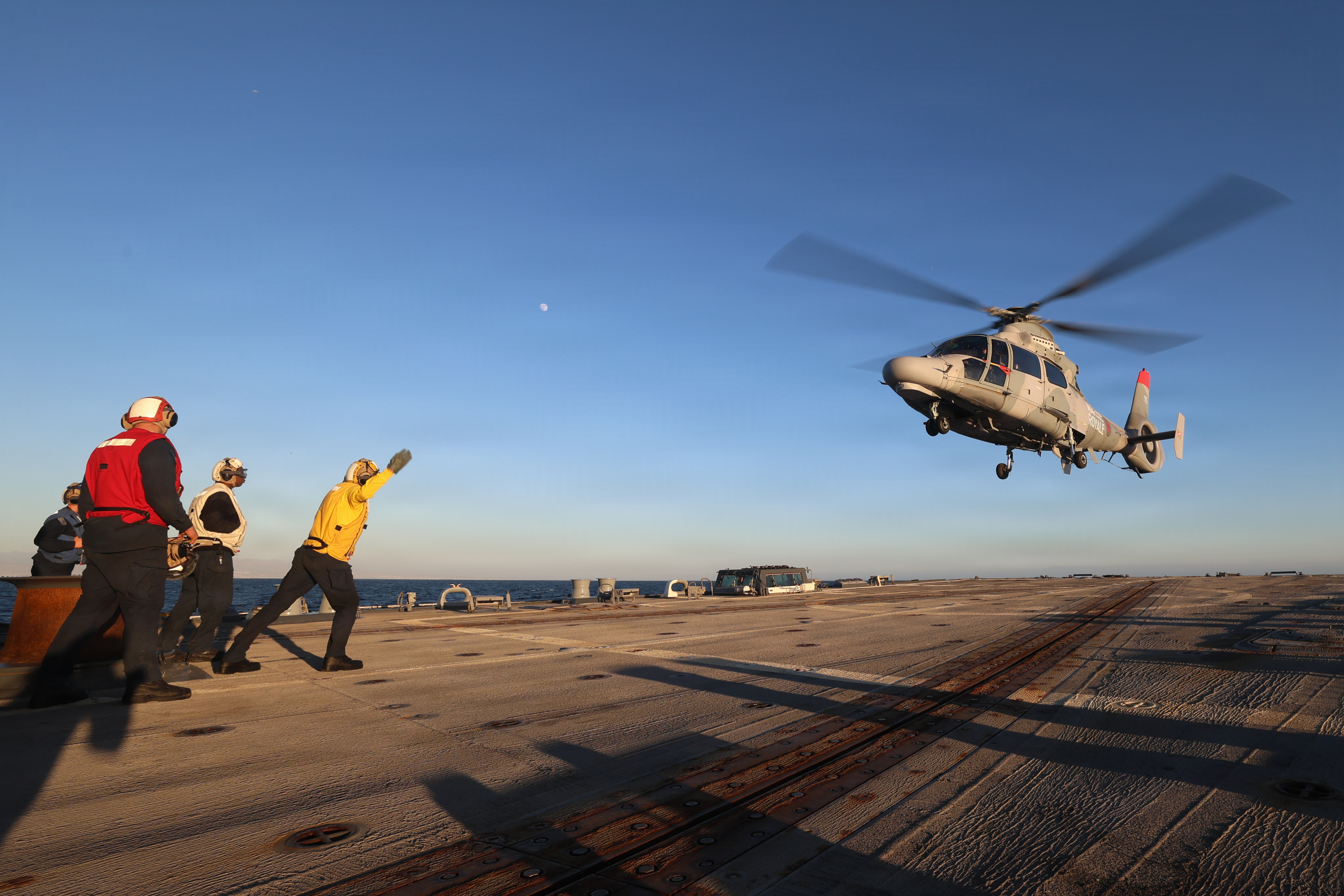
With our customer in Morocco, that has meant standing up Garda C2 site by site, and training the Royal Moroccan Armed Forces crews on how to run it; in Egypt, we have an in-country presence in Alexandria to install, integrate, and sustain the Egyptian Navy's maritime domain awareness program. What each navy ends up with is a capability shaped to how it operates, refined as it is used, and built to keep running long after Lyntris steps back.
The bottom line for defense decision-makers
For a naval leader or defense planner deciding where the next investment should go, sensing remains essential, but sensing alone no longer defines maritime advantage. As contested environments become more deceptive and more complex, operational effectiveness increasingly depends on how rapidly nations can validate information, coordinate partners, and translate awareness into action.



.png)