Insight
October 22, 2026
From Aperture to Architecture: RF Design Is Reshaping the Mission





Reusable launch, commercial buses, software-defined payloads and optical crosslinks changed the economics of space. Programs that once flew a handful of custom-built satellites now plan for hundreds and field them in tranches. Getting a spacecraft to orbit is no longer the constraint it was a decade ago.
Meanwhile, the demands on the aperture have grown faster than on any other part of the spacecraft. A single antenna is now expected to serve several bands and hundreds of beams, with coverage that can shift as the mission does. All of it has to fit inside a shrinking size, weight and power budget, and be built again for every satellite in the tranche.
That work is bound by physics and by the machine shop, and it moves on a slower clock than software.
The antennas and feeds that make up the aperture are where a spacecraft meets the RF environment. They set how much a satellite can sense and communicate, and where. That makes RF design an architecture decision, one that belongs at the start of a program.
Where satellite capacity actually comes from
Over the past three decades, some of the biggest gains in satellite capacity have come from the aperture. Picture a satellite covering the continental United States with one wide beam, where every user shares the same slice of spectrum. Break that coverage into 68 smaller spot beams and the same spectrum can be reused across the country, the way a cellular network reuses channels from one cell to the next. In that example, the satellite's 1 GHz of spectrum behaves like 17 GHz, and each beam is stronger because it is more focused. Today's high-throughput satellites carry that principle to hundreds of beams and more than 1 Tbps of capacity.
Multiband apertures push the same logic further. When one antenna on one launch serves several missions, the program pays for that antenna once instead of several times, and today's multiband feeds can do it at up to 92% efficiency.
The aperture can limit a mission just as easily. Earlier GPS satellites used antenna elements whose electrical center shifted slightly from one frequency to the next. That shift added small timing errors to the signal, which limited how precisely a receiver on the ground could pinpoint its location. Improving accuracy meant redesigning the antenna element itself so its center holds steady across all three GPS frequencies.
The old trade: flexibility or affordability
Hybrid architecture offers a way through the trade. Pairing the gain of a reflector with a small array of feeds lets beams be reshaped and repointed without building a full phased array. One K/Ka-band design for military communications does it with 37 feed elements, reconfiguring beams electronically across a theater while a gimbal moves them across global coverage. That is phased-array flexibility from 37 elements instead of thousands.
Programs want flexibility in more than where the beams point. The Space Force's Protected Tactical SATCOM–Global satellites will carry dedicated military X-band and Ka-band payloads, built to keep existing wideband users connected while adding an anti-jam waveform for contested environments. Each of those requirements lands on the aperture.
Design and manufacturing now happen together
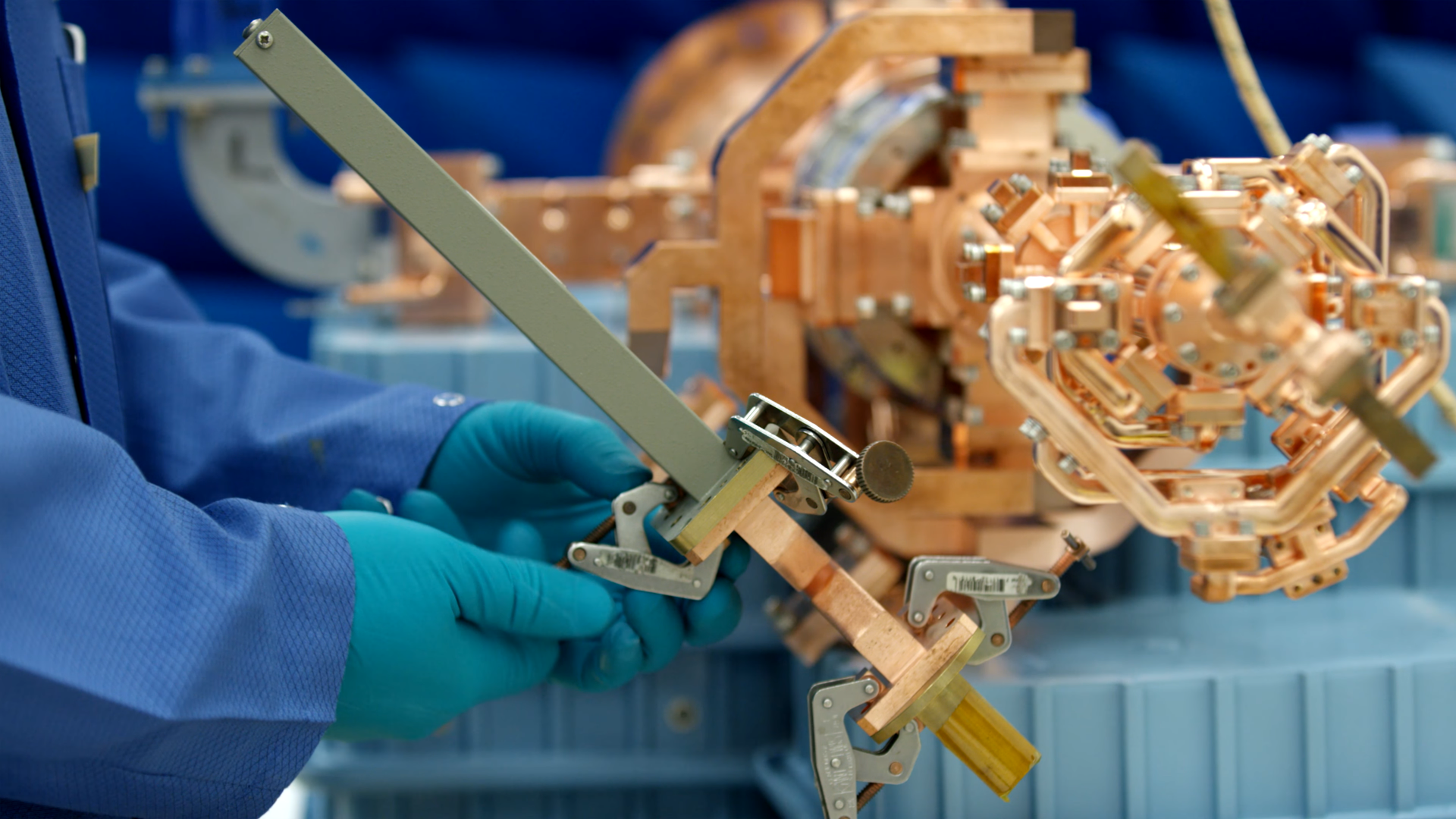
An architecture only matters if it can be built, at quantity and on schedule. Conventional feed assemblies are machined from aluminum blocks, electroformed, dip-brazed or cut on wire EDM, then joined through flanges and fasteners. Each interface adds weight, volume and a tolerance stack-up to manage.
At Lyntris, we print those assemblies as one piece. Our dual-band K/Ka feed for high-throughput satellites combines the horn, septum polarizer and two diplexers in a single monolithic part. It weighs 0.11 lb, against 0.54 lb for the conventional build: five times lighter. All three units measured better than 20 dB return loss in both bands and under 0.6 dB axial ratio, closely matching simulation even at Ka-band's short wavelengths.
Printing has historically traded surface finish for speed. Our proprietary process delivers RF performance comparable to or better than machined Al 6061, with a smoother surface and lower insertion loss. It also reaches hardware that is hard to machine at all: a 1-18 GHz quad-ridge horn with better than 30 dB port isolation, and feeds operating from 18 to 55 GHz.
These parts are qualified and deployed on multiple programs, built within an integrated design, build and test operation. It is the same approach behind our additively manufactured RF hardware already on orbit.
What this means for programs
For a prime or a program office, this changes when the aperture gets decided. It sets how much capacity a program gets and how far its coverage can flex, so it belongs among the first architecture decisions a program makes.
Hybrid designs let tranche-scale programs field reconfigurable beams without phased-array cost at every node. Multiband apertures consolidate missions onto fewer antennas and fewer launches. And the manufacturing path decides whether a design can be built at quantity at all: monolithic parts cut mass, remove the joints that fail first under vibration and thermal cycling, and shorten the path from design to orbit.
The programs that capture those gains will treat RF design as a first-order architecture decision. Lyntris brings RF design, additive manufacturing and test into a program at the architecture stage, while the aperture can still shape the mission.
If your program is setting aperture requirements now, our RF engineering team can help you run the trades early.
Contact our team here to discuss your missions RF requirements.