Insight
September 3, 2026
Additive Manufacturing Breaks the RF Bottleneck

.avif)





Space and defense programs are being asked to field more satellites, cover more orbits and deliver more sensing capacity on shorter timelines. The industry has responded by increasing launch cadence and advancing onboard processing. But the RF hardware that enables spacecraft to sense and communicate - the feeds, horns, filters, and antennas - has largely not kept pace. Much of it is still built the way it was thirty years ago, and that is the constraint the proliferation era keeps running into.
Legacy RF hardware runs on quarters
A high-performance feed assembly has traditionally come out of aluminum billet, with the critical junctions electroformed in copper to hold tolerance, or dip-brazed and cut on wire EDM. The results are excellent and the process is unforgiving of schedule. Lead times run in quarters, tooling has to be ordered before the first part exists, and every assembly carries hand-built joints that become failure points under vibration and thermal cycling, and sources of passive intermodulation in the RF path.
That math works when a program flies a handful of exquisite satellites. It breaks when the same program needs hundreds of nodes on orbit, or when a requirement shifts faster than a tooling order can clear.
The barriers to additive have fallen
Additive manufacturing has been the obvious answer for years, and for years it was not ready. Printed parts came off the machine rough enough to cost real insertion loss, and the industry lacked both the standards and the flight record to trust them on a mission. Both gaps have closed. NASA and the European Cooperation for Space Standardization have published additive standards for space, and prime contractors including Boeing, Maxar, and Northrop Grumman now fly printed RF parts, Lyntris has over 2,000 additively manufactured antenna currently in orbit and Lockheed Martin has qualified its first complex additively manufactured antenna for spaceflight on GPS III. The U.S. Department of Defense has funded domestic titanium-powder production under the Defense Production Act to secure the metal supply chain these processes depend on, and additive is now among the fastest-growing parts of aerospace and defense manufacturing.
Speed only matters if the RF holds – and turns out, it does. We recently printed a dual-band K/Ka horn cluster — seven elements, each with its own feed network, as thin-wall assemblies — into a package that weighs half a pound. Its return loss beats 22 dB at K-band and 21 dB at Ka-band, insertion loss stays under 0.4 dB, and efficiency sits near 90%. We also built a tri-band cluster combining four Ku-band horns with a K/Ka feed, which went from design to tested hardware in a matter of days; the input match was better than 25 dB, port isolation better than 27 dB, and axial ratio under 0.17 dB across the band.
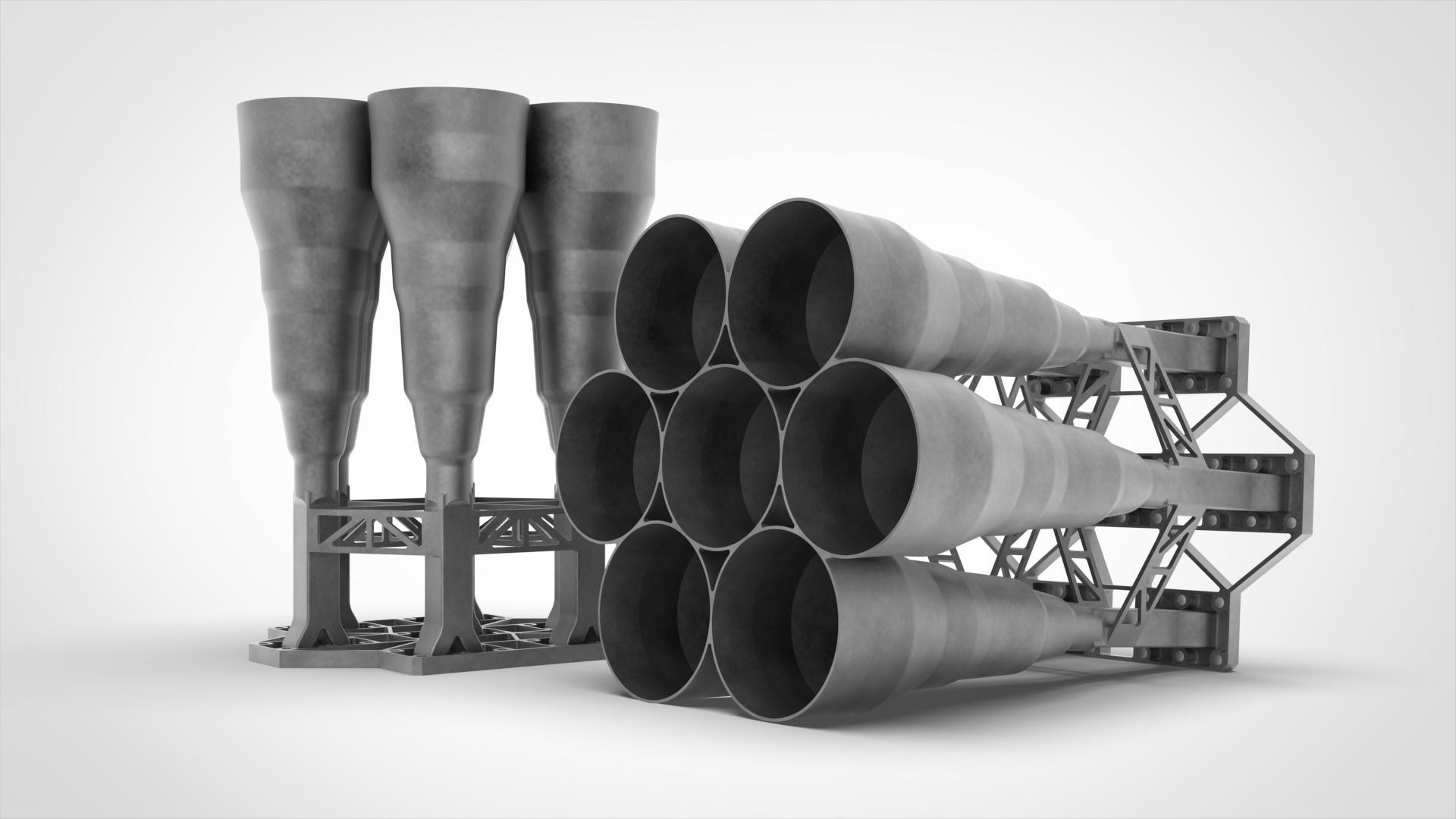
Additive enables what machining cannot
Speed is only half of what additive changes. Building layer by layer removes the brazed joints and hand-soldered interfaces that fail first in extreme environments, and it puts geometry on the table that a mill cannot reach: internal channels, integrated thermal paths, and multiple bands consolidated into a single aperture. Scale comes with it. NASA’s Jet Propulsion Laboratory has demonstrated additively manufactured, metal-only metasurface antennas built from several thousand sub-wavelength elements on a single aperture, the low-profile, low-mass design SmallSats and CubeSats are built around. The same process that prints one monolithic feed prints an array, which is where production volume for a constellation stops being a bottleneck.
Any supplier can buy a printer, but the advantage lives in the chain around it. At Lyntris, additive manufacturing sits inside an integrated design, build, and test operation with more than $45 million invested in end-to-end capability. Parts print in laser powder-bed fusion at 30-micron layers, on an envelope reaching 19 by 11 by 14 inches with quad 400-watt lasers, then move through proprietary finishing, including chemical smoothing and autocatalytic metal deposition, that brings internal RF surfaces below what the printer makers advertise. RF characterization and environmental testing happen in-house, so qualification does not wait on a supply-chain handoff. Every process runs through an AS9100 quality system with CT scanning, tensile coupons, and RF testing. That discipline is why the results hold at scale. On one next-generation satellite antenna, the team integrated roughly 1,600 additive RF components, cut size and mass by 30% to free payload capacity, and delivered the full program in under two years.
What this means for a program office
For a prime or a program office, this is a risk decision before it is a manufacturing one. RF hardware built the old way carries schedule that will not compress, mass that cannot be recovered, and a supplier base thin enough to sit on the critical path as a single point of failure. Additive, qualified and owned end to end, changes that posture. Design decisions can hold later into the program, and tranche quantities become achievable without waiting on a tooling queue. The 30% mass an additive architecture gives back is payload capacity that flies instead of structure that does not. A domestic, vertically integrated source is one less industrial-base risk to carry up the chain.
Lyntris has additively manufactured RF hardware on orbit today and has delivered a complete satellite antenna in a fraction of a conventional program’s timeline. Programs designed around additive can capture its full schedule, mass and supply-chain advantages. Satellites get the headlines, but the hardware that lets them sense and communicate increasingly determines when they reach orbit.