July 3, 2026
250 More
.avif)




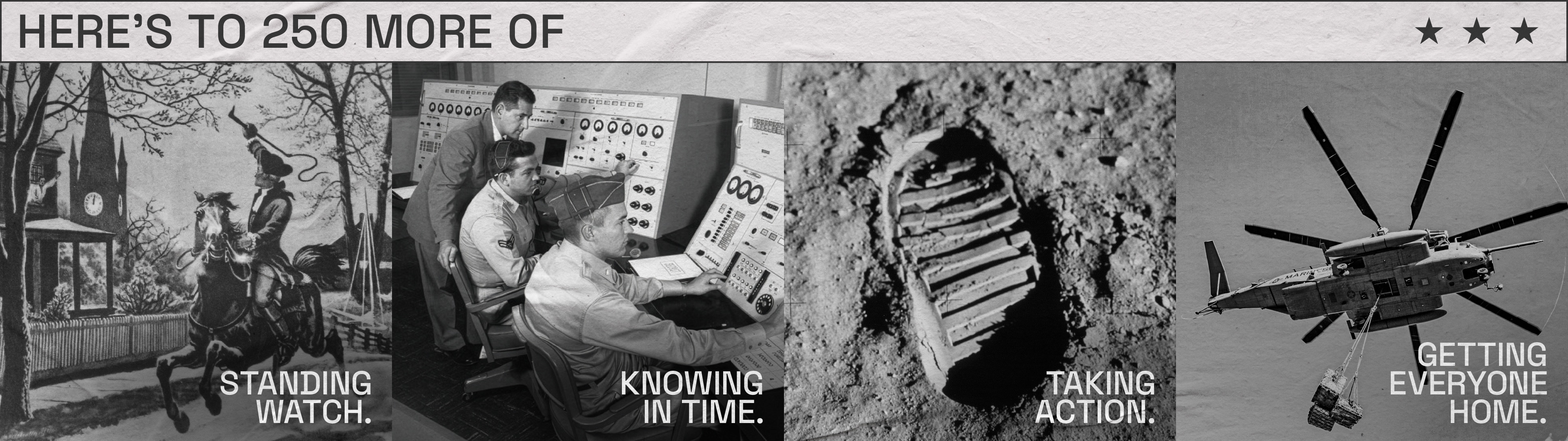
Two hundred and fifty years is a long time to keep a country safe. On the anniversary, it felt right to look back not just at the battles and the speeches, but at the work underneath them — the four things that have had to happen, in order, for there to be a 250th at all.
The tools have changed, but the mission hasn't: someone still has to see the threat first, make sense of it before it's too late, take action, and keep everyone supplied long enough to finish the job.
Keeping watch.
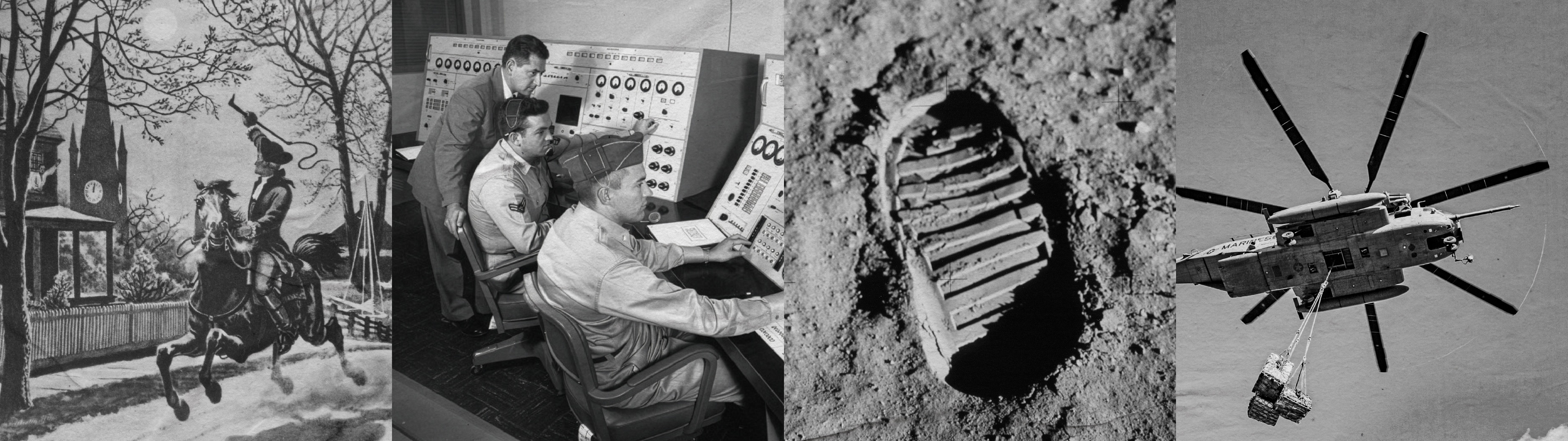
It started with someone willing to stand the watch. Before the muskets, before the Declaration, there was a man in a church tower on the night of April 18, 1775, with two lanterns and a job: see it coming, and tell the people who needed to know. One if by land, two if by sea. The Revolution turned on a signal that had to be read correctly, in the dark, with no time to ask again.
That mission never went away, it just moved north and got colder. A century and a half later, that watch became the Distant Early Warning Line: radar stations stretching across the Arctic, crews sitting through forty-below winters looking for the first sign of Soviet bombers crossing the pole. Then came NORAD, turning thousands of sensors into a single picture of the skies above North America.
Every generation builds a different watchtower. Today it's software, sensors, and data - different technology with the same assignment: see the threat before it becomes a problem.
Reading the signal.
Seeing isn't the same as understanding. The lantern told you ships were moving, but it didn't tell you what to do about it, and the space between we have information and we know what it means is where history tends to turn.
One of the clearest examples happened beneath Pearl Harbor in the spring of 1942, where a small team of Navy codebreakers known as Station HYPO, led by Commander Joseph Rochefort, believed the Japanese were planning an attack on a target they called "AF." They were convinced AF meant Midway, but they needed proof. So they had Midway broadcast an uncoded message that its water purification system had failed. Within a day, Japanese communications reported that "AF" was short on water.
That was enough -- the U.S. Navy positioned its carriers and, between June 4 and 7, ambushed the Japanese fleet in one of the decisive victories of the Pacific War.
The answer had been there all along; what mattered was recognizing it before the enemy acted, and having the confidence to act on what you knew. That's still the hard part.
Acting anyway.
Information doesn't win anything by itself; eventually someone has to make the call.
On June 6, 1944, thousands of American and Allied paratroopers jumped into darkness over Normandy. Wind scattered formations, radios failed, and entire units landed miles from where they were supposed to be. Many spent the first hours of D-Day fighting with whoever they could find, trying to accomplish missions that suddenly looked nothing like the plan. They didn't wait for perfect information, but they acted anyway.
Twenty-five years later, another crew found themselves in a different kind of uncertainty. We remember Apollo 11 as a clean triumph — one small step — but the landing itself was four minutes of pure nerve. As the lunar module descended, the guidance computer threw a 1202 alarm, an overload warning neither Armstrong nor Aldrin had ever seen in training. Armstrong, seeing the computer was steering them into a boulder field, took semi-manual control and flew the module to a clear patch of ground. They touched down with about 15 seconds of fuel left.
Different mission, but the same job. Knowing what to do is rarely the hardest part; the hardest part is doing it while the alarms are going off, the clock is running down, and no one has rehearsed this exact moment.
Keeping it going.
And here's the part that rarely gets talked about. In March 1942, about ninety days after Pearl Harbor, the Army Corps of Engineers began building a road through subarctic wilderness — 250,000 tons of material and 10,000 soldiers, leap-frogging their way across 1,700 miles. At least 11,000 servicemen and, at the height of it, nearly 16,000 civilians did the work, much of it by hand in frozen ground, with spring mud that swallowed trucks whole. When the heavy equipment hadn't arrived yet, they improvised — a bulldozer dragging a grader they'd built out of local timber.
At the same time, American shipyards were launching Liberty Ships at a pace the world had never seen. By the end of the war, they had built more than 2,700 of them, replacing losses faster than the enemy could sink them, and carrying the fuel, ammunition, food, and equipment that kept Allied forces fighting across two oceans.
No statue gets built to a supply road, and few people remember the ship that delivered the fuel. But the brave thing happening at the front only stays possible because of the unglamorous work happening behind it. Across 250 years, the side that could keep going has usually been the side that prevailed.
Passing the watch.
So that's the work: stand the watch, read the signal, act before certainty arrives, and keep everyone moving.
Across 250 years, the technology has changed. Lanterns became radar, radar became satellites, maps became networks and reports became data. The tools keep evolving because the mission demands it, but the mission itself hasn't changed.
Two hundred and fifty years ago, a handful of people decided this country was worth the risk. Everything since — every warning caught early, every hard decision made in time, every courageous act, every quiet logistical miracle — has been part of keeping that decision alive. The watch belonged to them before it belonged to us, and we don't intend to be the generation that sets it down.
Happy birthday, America. Here's to 250 more.