Insight
June 1, 2026
Left of Bang: Where the Future Fight Is Won or Lost

.avif)





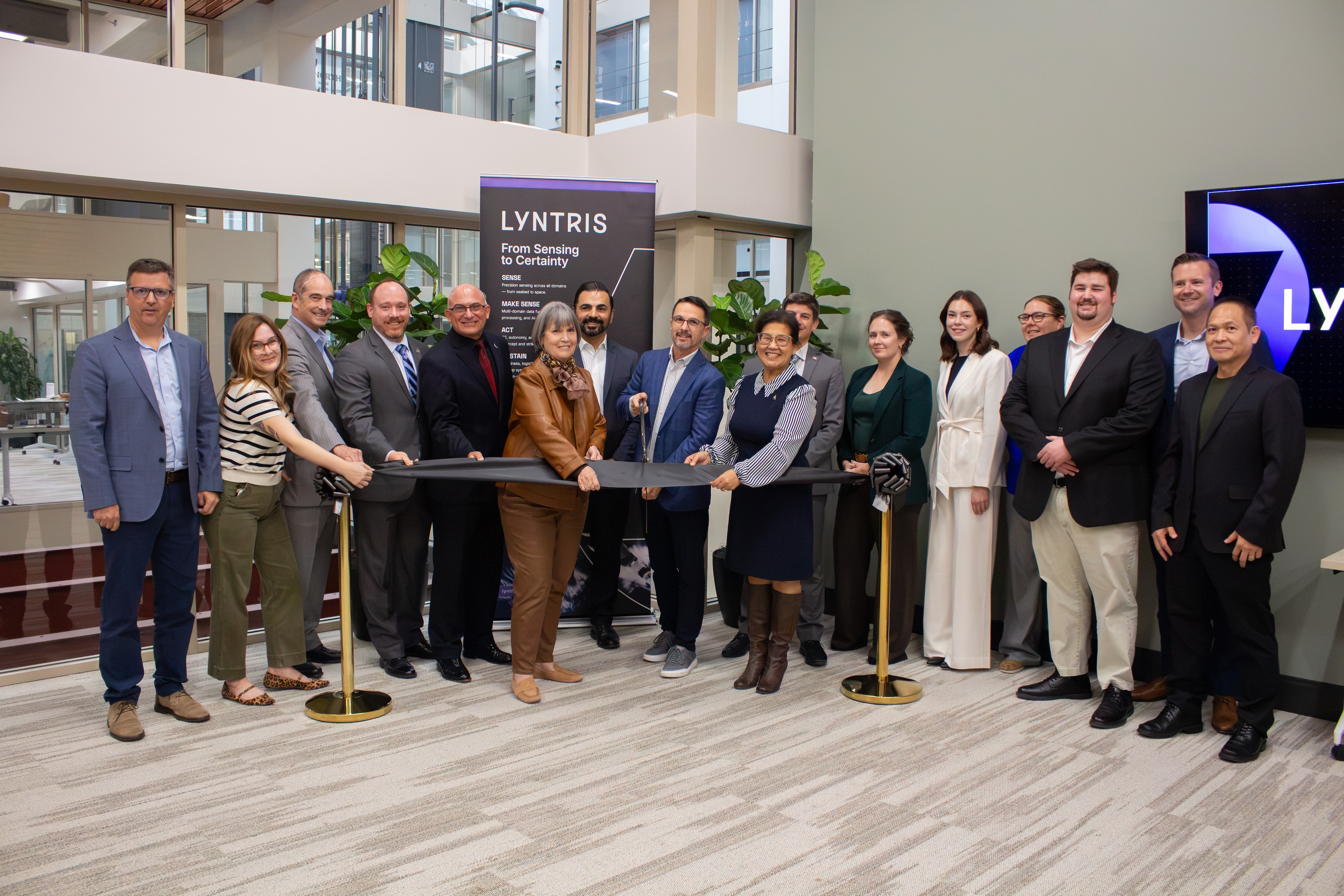
At last month’s Inside the Dome event in Washington, D.C., hosted by Tectonic and Payload, Lyntris convened military and industry leaders for a discussion on one of the defining operational challenges in modern defense.
Moderated by Jake Swenson, President of Industries at Lyntris, the panel brought together Lt. General Stephen Twitty (U.S. Army, Ret.) and Lyntris leaders Quentin Donnellan and Madison Dye to explore what it takes to detect threats earlier, make sense of complex battlespace data, and enable commanders to act before critical windows close — the operational space known as "left of bang."
Earlier that day, General Michael Guetlein, Director of Golden Dome for America, set the stakes plainly: the technologies behind next-generation missile defense already exist. The operational challenge is deploying them at the speed, scale, and reliability modern threats demand.

Decision Time Is Collapsing
Modern threats do not follow predictable timelines. Hypersonics, maneuvering reentry vehicles, autonomous systems, and distributed attacks reduce the time available to detect, decide, and respond. While a ballistic missile threat may allow minutes to respond, a maneuvering hypersonic threat compresses that to seconds — with no guarantee of a predictable flight path.
Lt. General Twitty framed the operational stakes simply, by saying commanders need technologies that help them mitigate risk, exploit fleeting opportunities, and disrupt an adversary’s decision cycle before the adversary can act.
“The battlefield is moving so fast,” Twitty said. “Sometimes we do not see the opportunities that present themselves because we focus on the fight and not the branches and sequels that occur in the fight.”
That challenge sits at the center of homeland defense architectures like Golden Dome, where maneuvering threats leave little margin between detection and response.
Collecting Data Is Not the Problem
The panel returned repeatedly to the same issue: collecting data is easier than turning it into action.
Madison Dye, Lyntris VP of C5ISR, described the complexity of tracking modern threats across proliferated sensing architectures, where systems must process inputs from infrared, radar, EO, thermal, SAR, and other modalities operating simultaneously across space and terrestrial environments. The challenge is turning that volume of information into usable decisions before the window closes.
“The ground has really been one of the biggest problems to solve,” Dye explained. “Can we fuse it together and then get it to a General where he can make a decision in the right amount of time to where it actually matters?”
Lt. General Twitty described the problem from an operator’s perspective, describing operations centers dominated by disconnected systems, redundant data feeds, separate interfaces, and manual coordination between stovepiped technologies.
“The biggest frustration for me throughout my career was either working in an operations center or going into an operations center,” Twitty said. “You see all these boxes, all these fiber optic cables, all these panes of glass everywhere… and it sure isn’t efficient in terms of moving data where it needs to be.”
"You have to cut through all that the noise," Donnellan added. "Surface the threat. Get it to the decision-maker before the window closes."
Contested Environments Expose Bad Assumptions
The panel discussed how assumptions that work in commercial environments often fail immediately in operational ones. Quentin Donnellan, Lyntris President of Decision Systems, shared examples from his time at the Balikatan 2026 exercises in the Philippines, where software teams confronted a reality familiar to deployed operators but often overlooked in technology development environments.
“You run out of diesel in your generator,” Donnellan said. “Now your operators are trying to find fuel just to keep the app running.” He carried this warning directly to homeland defense: "There's a danger in thinking that those same problems that afflict the 25th infantry on the other side of the planet won't affect us here. When networks go down, that's a challenge."
Lt. General Twitty agreed, “What works in Boston, Massachusetts will not work in Phoenix, Arizona. And if you go back to my time in the Army, I learned that the hard way in Desert Storm." Systems have to be built for where the operator actually is, not where the engineer assumes they'll be.
That reality is shaping defense priorities across distributed operations and resilient system design. Systems built around assumptions of uninterrupted connectivity and persistent cloud access may perform well in controlled environments but fail when operators need them most.
The Mission Fails at the Seams
The discussion repeatedly returned to the same operational failure point: systems that work independently but break at the seams.
Defense programs spent years optimizing exquisite standalone capabilities. Modern operations require sensing, software, hardware, and command systems to function together under pressure.
“We have to architect systems that will withstand what our warfighters will need,” Dye said. “It’s no longer small pieces of hardware that are siloed and disjointed. It all has to work together in an architecture and framework as a unified system.”
The challenge extends beyond technology. Echoing General Guetlein’s earlier points, the panel emphasized the need for acquisition and integration models that move faster, connect systems earlier, and deliver usable capability before threats evolve beyond the pace of deployment.
The So What
The pace of modern conflict leaves little margin between detection and response. Systems that cannot share data, maintain connectivity in degraded conditions, or reduce cognitive burden on operators become liabilities regardless of how advanced they are individually.
The discussion at Inside the Dome reinforced a broader shift already shaping defense programs: connecting sensing, software, infrastructure, and command into resilient systems built for compressed timelines and degraded conditions.
That is what operating left of bang requires.