Insight
November 20, 2026
What the B-52 Audit Reveals About Parts Obsolescence







The Air Force plans to keep the B-52 flying into the 2050s, roughly a century after the prototype first flew in April 1952. Getting there means replacing the TF33 engines that Pratt & Whitney stopped building in 1984, swapping out the radar, modernizing the cockpit, and refreshing avionics that have been patched for decades. It also means sourcing a long tail of smaller parts whose original manufacturers moved on years ago.
When the DoW Inspector General audited how the B-52 program office handled that last job, the findings were blunt. The program had never signed its plan for managing diminishing manufacturing sources and material shortages (DMSMS), and it had not developed a complete bill of materials for B-52 spare parts. Those gaps contributed to spare part shortages on one of the most important aircraft in the inventory.
The B-52 is an extreme case, but hardly an isolated one. The B-2 Spirit has faced obsolete microelectronics and circuit card assemblies, forcing maintainers to cannibalize parts from other aircraft. The Navy's submarine industrial base faces similar challenges as legacy components become obsolete and suppliers exit the market. Across the defense enterprise, these challenges underscore the growing need to identify and address supply chain vulnerabilities before they disrupt operational readiness.

Obsolescence is a timing problem
Defense platforms are designed to serve for decades, while the commercial electronics inside them follow market cycles measured in a few years. DoW is a minor customer in the global electronics market, so when a manufacturer discontinues a low-volume part, defense demand rarely changes the decision.
When a component is discontinued, program managers have several options: purchase enough remaining inventory to meet future needs, qualify a replacement part, find an alternative manufacturer, or redesign the affected assembly. Each option requires time and investment, and the available choices become more limited as the shortage approaches. Programs that identify obsolescence early can secure inventory or qualify alternatives before supply runs out. Those that discover the problem too late may face costly redesigns, production delays, or extended equipment downtime.
That's why people who have lived through DMSMS events measure success in lead time. A team that sees the problem two years out gets to choose its response. A team that learns about it when a depot work order stalls takes whatever is left.
Four questions every bill of materials should answer
Managing obsolescence well depends on answering a few basic questions about every part in a system:
- Who makes it, where, and from what materials?
- Which sub-tier suppliers sit behind the vendors on the prime's list?
- Is there a qualified second source if the current one exits the market?
- Which other platforms and product lines depend on the same part?
For many programs, those answers are scattered across a patchwork of incomplete BOMs, scanned drawings, ERP records, and commercial databases. For older platforms, the government may not have complete technical documentation because it wasn't included in the original acquisition contract. That's how a program ends up where the B-52 did, sustaining an aircraft without a complete list of what's in it.
The stakes go beyond availability. A 2012 Senate Armed Services Committee investigation uncovered roughly 1,800 cases of suspected counterfeit electronic parts in the defense supply chain, totaling more than a million parts, with China identified as the dominant source. Of the cases the committee traced back through the supply chain, 70 percent of the suspect parts came from China. Counterfeits thrive where traceability is weak, and traceability tends to be weakest for the old, hard-to-find parts that obsolescence pushes programs toward.
Where defense supply chain risk management breaks down
The market has responded with tools for nearly every slice of this problem. Separate products track lifecycle status, supplier financial health, geographic concentration, and material sourcing, and each is useful on its own terms.
The trouble starts when a program tries to act. An obsolescence alert tells you a part is going end-of-life, but itcan't tell you whether there is stock in the depot, whether a qualified alternate exists, or whether the sole supplier is showing financial strain. Someone on the program has to pull those threads together by hand, across engineering, supply and contracting, before anyone can rank the risk. Under that workload, teams work whichever alert is loudest instead of proactively managing risk across an entire fleet.
Even critical information that does exist often fails to reach the people who need it. When GAO reviewed how DoW managed single-source supply risk, the program officials it interviewed were unaware of the department's own report identifying the most critical single-source parts (GAO-17-768). Programs that share a component regularly discover the same obsolescence problem independently, and each one pays separately to solve it.
Predictive parts obsolescence management with Tesio
Effective obsolescence management requires connecting information across systems, understanding which risks pose the greatest threat to readiness, and giving teams a way to act on those risks before they become shortages.
Lyntris built Tesio to close the distance between spotting a risk and resolving it. The platform combines commercial component intelligence, lifecycle data, and supplier information with a customer's own enterprise data, including BOMs, inventory and procurement history.
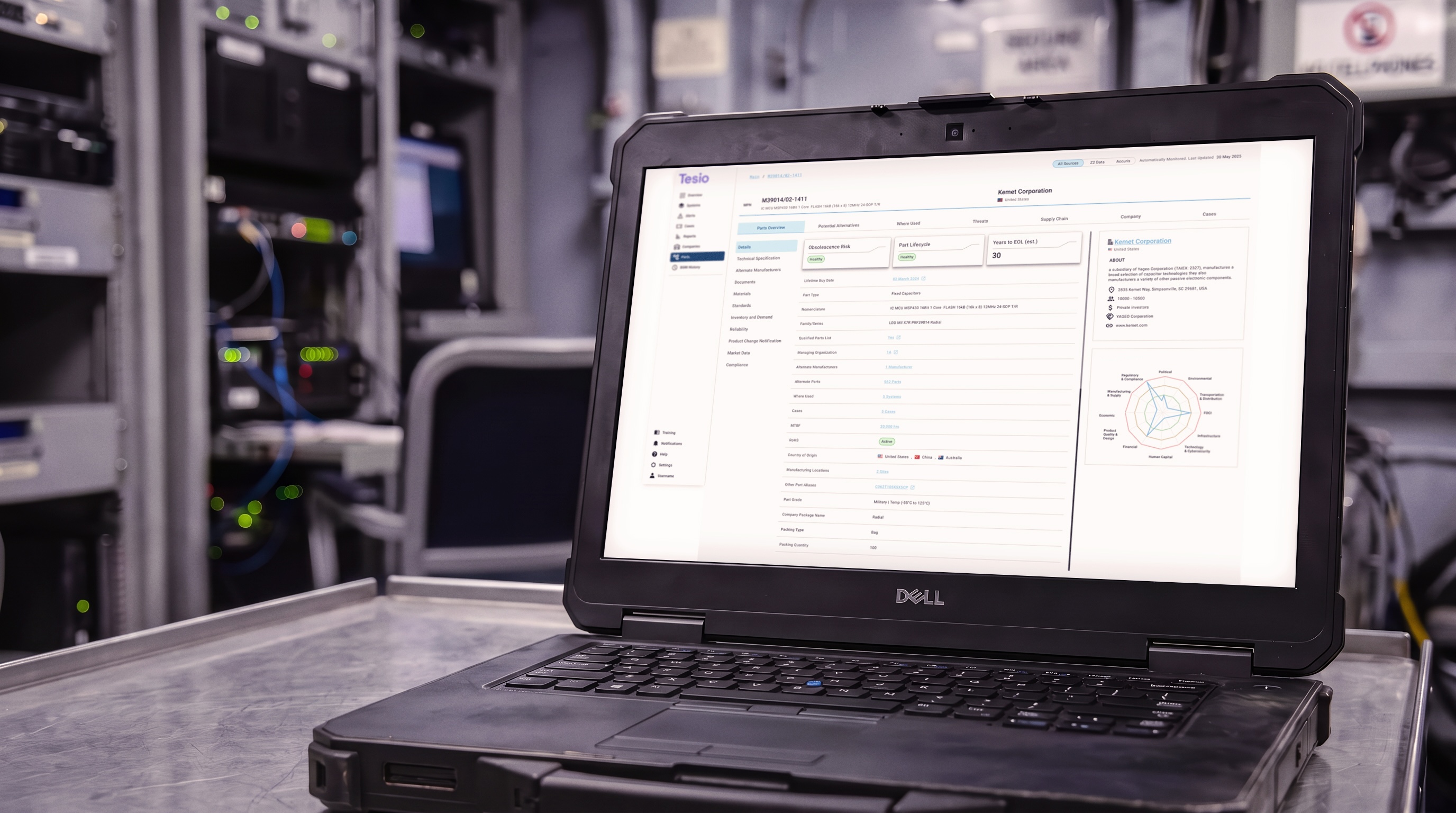
Traditional obsolescence tracking focuses on component lifecycle status, but a part that's still in production can pose significant risk if failure rates are increasing or its sole supplier is struggling. Tesio's predictive risk engine analyzes reliability data, operating hours, maintenance patterns, inventory levels, and supplier performance alongside commercial lifecycle intelligence to identify components that could threaten mission readiness. Confidence indicators help users evaluate the strength of the underlying data.
When a risk is identified, engineers, logisticians, supply chain managers, and product support teams can work from a shared mitigation case. They can investigate contributing factors, evaluate options such as bridge buys or redesigns, assign actions, and track progress toward resolution within the same platform.
Tesio also analyzes multiple BOMs and programs at once. A manufacturer can identify components shared across product lines before a discontinuation affects multiple programs. Government program offices can recognize common vulnerabilities across platforms and coordinate sourcing or mitigation strategies rather than addressing them independently. Because Tesio integrates with existing product lifecycle management (PLM), enterprise resource planning (ERP), and legacy systems, the analysis can keep pace as configurations, inventories, and supplier relationships change.
For programs with incomplete BOMs or technical documentation that exists only in drawings, Lyntris is also applying AI-assisted methods to reconstruct bills of materials from technical drawings and data packages. This addresses the type of documentation gap identified in the B-52 audit, providing the foundation for more comprehensive parts obsolescence analysis and proactive sustainment planning.
Sustainment readiness for legacy fleets and new programs
The defense industrial base is being asked to keep aging platforms mission-capable while accelerating production of new systems. Legacy programs need early warning on the parts and suppliers most likely to disrupt sustainment. New programs need to evaluate component availability, reliability, and sourcing dependencies while designs can still change.
The transition from development to sustainment introduces additional risk. As systems enter service, critical knowledge about component reliability, supplier decisions, and design tradeoffs can become fragmented or lost between teams. Maintaining that information throughout the system lifecycle gives sustainment organizations a stronger foundation for identifying risks and managing corrective actions.
The team behind Tesio has experienced these challenges firsthand, from managing military supply chains and acquisition programs to sustaining electronic warfare systems beyond their planned service lives. That experience shaped a platform designed to preserve supply chain visibility, support collaboration, and help programs address obsolescence risks before they affect operational readiness.
See how Tesio scores obsolescence risk across your BOMs →