News
September 28, 2026
Off World: Ground Control to Major... Problems
.avif)





Lyntris engineers had high hopes for the 3D-printed waveguide when it came back from the manufacturer. The part looked promising, so the team put it in the test chamber, powered it up and waited for the RF return. Nothing came back.
“We looked down the barrel. Sure enough, there was a structural support right in the middle,” recalled Madison Dye, Lyntris’ VP of Business Development, C5ISR.
The supplier had added a brace to address a structural concern, obstructing the channel intended to carry radio-frequency energy. A change meant to improve the part had compromised its function.
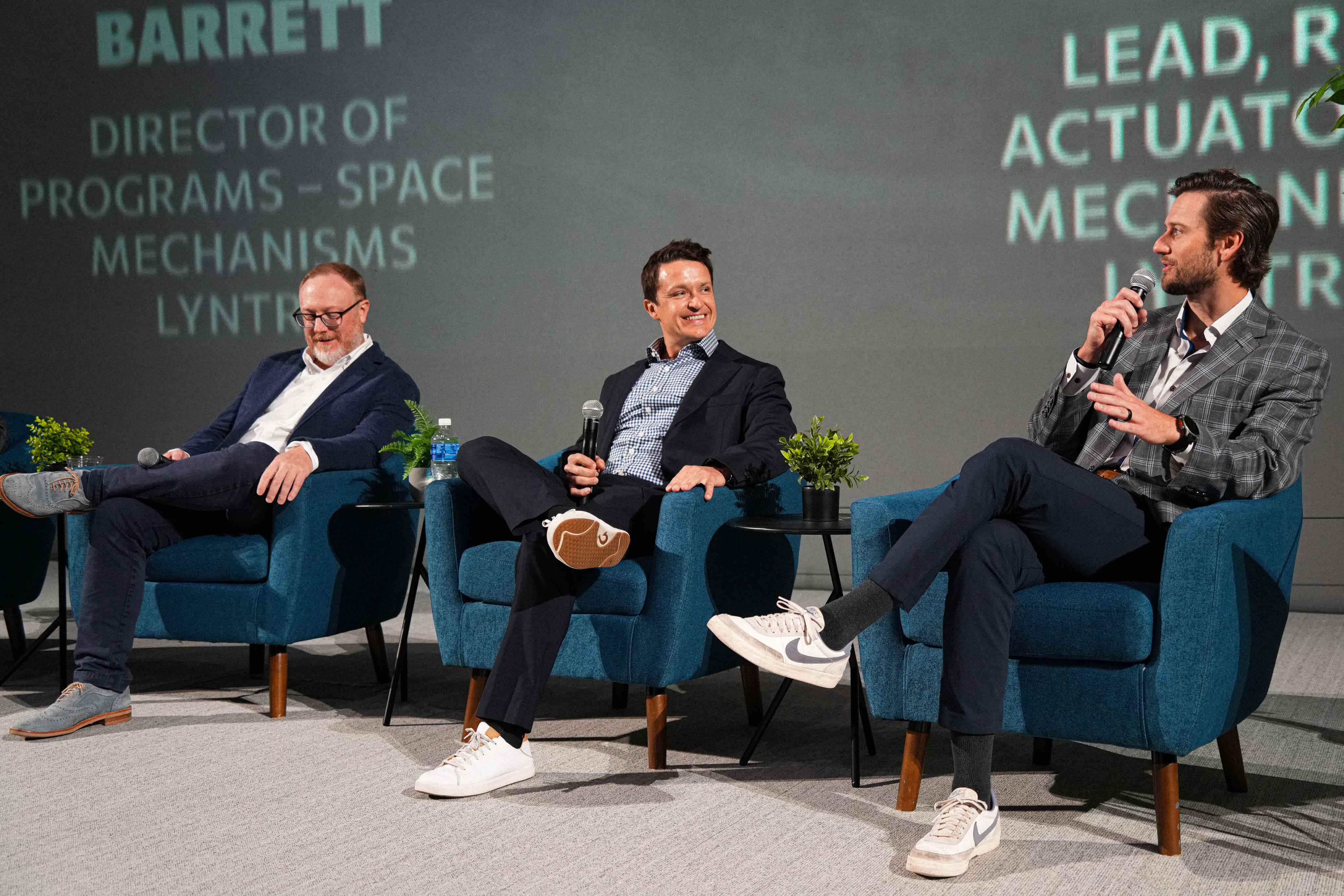
Dye shared the story during “Ground Control to Major… Problems” at Payload’s Off World event in Houston last week. Moderated by Payload Pro Research Director Jack Kuhr, the panel also featured Matthew Barrett, Director of Programs, Space Mechanisms, and Josh Figuered, Lead, R&D Actuators & Mechanisms.
Across the conversation, the panelists traced mission-level problems back to reasonable local decisions made without the full mission in view. Here are five lessons they shared for catching those decisions while the design can still change.
1. Give every supplier the mission
The waveguide problem developed at the intersection of two disciplines. The manufacturer had focused on structural integrity without accounting for what the change would mean for RF performance.
Dye connected that experience to how aerospace programs have traditionally divided work among specialized teams, with suppliers handling individual components while a prime contractor managed the overall mission. Broader access to engineering tools creates more opportunity for specialists to contribute across the system, provided they understand its purpose.
"What we pride ourselves on doing at Lyntris is working with our subcontracting team and treating them more like mission partners rather than just personnel who are providing components," Dye said. "You give people who are experts in their field an understanding of the mission, and they are able to do trade studies rapidly."
Barrett added that suppliers with this context can identify opportunities to simplify a design and flag decisions that create dependence on a single source. Giving them that opportunity means explaining why particular features matter, identifying constraints that must be preserved and reviewing proposed changes across disciplines.
2. Design the harness into the system from the start
Asked about the challenges of designing hardware for space, Figuered picked something easy to overlook: wiring harnesses. Although harnesses connect a payload’s components, mechanical engineers can leave them until much of the surrounding design is fixed.
That becomes especially troublesome in mechanisms, where wires must flex repeatedly without wearing out. Harness assembly also involves skilled manual work, creating opportunities for error alongside the challenges of routing and movement.
“What you think is a wire with a very small bend radius, in reality, ends up being enormous, and you have to accommodate for that in your design,” Figuered said. Reflecting on projects across his career, he added, “I’ve seen it cause problems. I’ve seen it be the source of mission failures.”
His recommendation was to consider harnessing from the beginning, including whether some connections could be eliminated. That gives engineers more options than trying to route wires through a mechanism whose geometry and movement have already been established.
3. Use early hardware to test your assumptions
The panel described an increasing emphasis on building hardware early and using test results to inform final requirements. Prototypes can expose interactions missed in analysis and reveal manufacturing difficulties while teams still have flexibility to respond.
Dye connected that approach to the “pay me now or pay me later” curve of systems engineering. Working through subsystem relationships early allows teams to resolve conflicts before more of the program depends on the design.
The waveguide example illustrated both sides of that equation: testing caught the problem on the ground, while better alignment between the mechanical and RF requirements could have helped prevent it.
4. Design for the supply chain you’ll actually have
Figuered’s question for new designs was straightforward: “Can we do this simpler?”
He described parts drawn to tolerances so demanding that “only a few manufacturing companies can make this, and even they often make it wrong.” Those choices can expose programs to limited capacity, nonconforming deliveries and delays that threaten launch schedules. Simpler designs and components available from multiple suppliers can reduce those pressures.
As production volumes grow, Figuered also hopes to see space engineers use measurement and calibration to account for manufacturing variation where the application permits it. Understanding each assembly as built could help achieve precise system performance without requiring extreme precision from every part.
Barrett cautioned that future component availability is itself an assumption worth examining.
“My biggest worry is that the cost assumption for space, that there is going to be a McMaster-Carr catalog available of space components in the three to five-year time horizon, is not going to play out,” he said.
Suppliers of chips, motors and gears also serve terrestrial industries competing for capacity. Barrett questioned whether space demand was reaching those suppliers strongly enough to secure the priority future programs might expect. Teams therefore need to examine sourcing constraints early, including assumptions that components will become readily available by the time they are needed.
5. Match the design to the mission’s lifespan and environment
When Kuhr asked how to build hardware that lasts for decades without anyone available to repair it, Figuered challenged the assumption that every customer needs such a long operating life. Some are choosing shorter pathfinder missions to test approaches before deploying larger constellations.
“We actually don’t necessarily even want it up for 10, 20 years because we want to be flying the latest technologies,” he said.
Some customers are also more willing to accept additional mass. Where the mission permits it, Figuered noted, engineers can build more torque into an actuator to provide margin for uncertainty and degradation over its operating life.
Those choices depend on the environment the hardware will face. Barrett, whose background includes oil and gas, contrasted lunar operations with remote terrestrial locations that still benefit from established support networks.
“There’s dozens of providers who could ship you power plants to any corner of the world. But that infrastructure does not exist when you go to the lunar environment,” he said.
Figuered highlighted power availability, survival through the lunar night and abrasive regolith as major concerns. Missions cannot assume ready access to repairs, replacements or resupply, making it essential to design around the actual operating conditions and duration. Those requirements determine where additional margin is valuable and where further optimization may add cost without enough benefit.
“You can’t vibe code for space”
AI is already changing some of this work. Dye described customers arriving with AI-assisted link budgets, giving communications discussions a more developed starting point. Barrett’s teams use AI to help prepare reports and format results, freeing engineers “to focus on the engineering instead of focusing on the paper pushing.”
Drawing on his earlier experience building humanoid robots, Figuered compared the effort those projects once required with what he sees newer tools enabling.
“It would take a room full of 20 software engineers a year to teach a humanoid robot how to walk poorly,” he said. “That can now be done in a week or two, and with maybe one or two software engineers.”
His team is beginning to use AI to help tune robotic controls, but engineers still need enough knowledge to evaluate the results.
“You do need to know the fundamentals. You can’t vibe code for space,” Figuered said.
As teams adopt faster tools and pursue more ambitious missions, they still need to understand how individual decisions affect the system, share that understanding with suppliers and test their assumptions while problems can be resolved on the ground.
Dye expects space infrastructure to become far more ordinary over the next 10 to 15 years, to the point that he says today's kids will ask, "Data centers were always in space. Where else would you put them?" Getting there depends on the disciplined, unglamorous work this panel described, and it's the work Lyntris teams do every day.
If you'd like to hear more about the unglamorous work, or the lessons we've learned the hard way so our customers don't have to, contact us to grab time with the team.